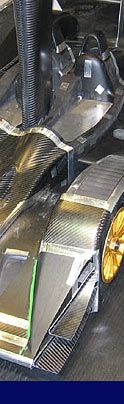
In 2005 the MG EX264 was the latest
in a long line of technologically advanced and aesthetically
pleasing racecars to emerge from the Lola factory in Huntingdon.
Over 8000 hours of CAD development work went into the design
of the car, while some 260 hours were spent in the windtunnel
to perfect the car's aerodynamics.
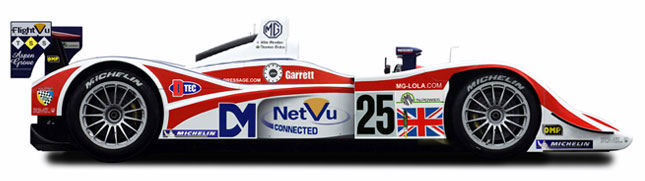
In its original
configuration, as raced in 2005, the EX264 was
developed in association with MG, RML and engine specialists
Judd. Based on the Lola B05/40, itself a comprehensive
redevelopment of the successful MG EX257 sports prototype,
the EX264 was immediately eligible for the ACO LMP2 class
at Le Mans as well as the Le Mans Endurance Series (now
Le Mans Series) and the American Le Mans
Series. The MG EX264 complied with all the regulations
and technical specifications of th day.
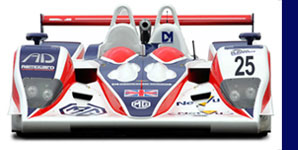 Although visually similar to the Lola B05/40 racecars, the RML car is
correctly designated as an MG Lola EX264. (Not, as has been
contrived by some, an "MGola", which seems a cumbersome
name for such a svelte and nimble car!). Under the
skin it features many significant differences that
stand it apart from its Lola-badged counterparts. Many
of these stem from the way RML continued development
of the previous MG EX257 after acquiring the ex-factory
racecars and campaigning those in 2003 and 2004. Much
of that on-going development was too valuable to be
lost when the current B05/40 chassis was released,
and with the blessings of both Lola and MG (at that
time still in operation), many of those innovations
were carried over to the new car. Several months before
the demise of MG Rover, the new RML racecar was fully
homologated as the MG EX264, and it proudly carries
the MG octagon to this day.
Although visually similar to the Lola B05/40 racecars, the RML car is
correctly designated as an MG Lola EX264. (Not, as has been
contrived by some, an "MGola", which seems a cumbersome
name for such a svelte and nimble car!). Under the
skin it features many significant differences that
stand it apart from its Lola-badged counterparts. Many
of these stem from the way RML continued development
of the previous MG EX257 after acquiring the ex-factory
racecars and campaigning those in 2003 and 2004. Much
of that on-going development was too valuable to be
lost when the current B05/40 chassis was released,
and with the blessings of both Lola and MG (at that
time still in operation), many of those innovations
were carried over to the new car. Several months before
the demise of MG Rover, the new RML racecar was fully
homologated as the MG EX264, and it proudly carries
the MG octagon to this day.
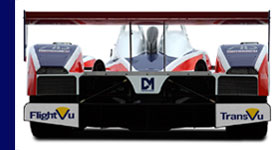 The chassis is an all-carbon fibre monocoque, with
symmetrical twin rollover hoops. This is encased within a
stunningly good-looking bodyshell constructed from pre-preg
carbon fibre with a honeycomb core for additional rigidity.
This meets the revised aerodynamic requirements introduced
during 2004 and means that the EX264 is likely to remain at
the forefront of prototype racecar technology for many years
to come. The rear wing and underbody are also of lightweight
carbon composite construction.
The chassis is an all-carbon fibre monocoque, with
symmetrical twin rollover hoops. This is encased within a
stunningly good-looking bodyshell constructed from pre-preg
carbon fibre with a honeycomb core for additional rigidity.
This meets the revised aerodynamic requirements introduced
during 2004 and means that the EX264 is likely to remain at
the forefront of prototype racecar technology for many years
to come. The rear wing and underbody are also of lightweight
carbon composite construction.
The front and rear suspension uprights
are fabricated from aircraft specification steel and TIG
welded. These elements link via double fabricated steel
wishbones with pushrods and rockers to three-way adjustable
damper units.
In 2005 the car raced with a
specially-developed MG V8 powerplant, created exclusively for
the EX264 by Judd. Normally aspirated, this unit took the car
to a class win at Le Mans in June 2005 and proved both
reliable and strong, rarely missing a beat all season. Having
enjoyed fantastic support from Judd all year, it was with
considerable regret that the team found it necessary to change
engines for 2006, reverting to the turbocharged AER 2-litre
engine that had previously powered the team's EX257s. Not only
did RML already have several of these engines "in stock", but
over the previous two seasons the AER unit had proven itself
exceptionally reliable, fuel efficient and responsive. It made
sense, both financially and in terms of race strategy, to make
the change. As was subsequently demonstrated by a second
consecutive class victory in the Le Mans 24 Hours of June
2006, the change proved to be a wise one.
The engine is mated to a Lola six-speed
sequential gearbox with semi-automatic paddle shift system.
A back-up manual gear-change system is also installed.
When first introduced, this back-up required that a driver
with paddle-shift problems made a 40 second pitstop to
initiate the changeover. However, the final refinement
merely demands a very brief moment of free-wheeling in
order to affect the switch, so the car does not even have
to stop. Two starter motors and paired alternators are
fitted for reliability, lightweight magnesium castings
are employed extensively throughout the car, and braking
is by 355 mm diameter carbon discs.
In 2007 Lola introduced the revised B07
chassis, and made available an updated aerodynamic kit
for the earlier B05 and B06 chassis. RML carried out extensive
testing and back-to-back simulations on both configurations,
and employed the revised "07" body kit at high
downforce circuits, such as Valencia in Spain. For the Le Mans
24 Hours the low-downforce "06" kit was employed.
The EX264 is fitted with a
fully-integrated computerised dash/data logger system with
steering-wheel mounted display, The military-specification
wiring loom is installed directly to the inside of the
monocoque for protection, access and reliability.
The
technical specification listed below relate to the car
as prepared for the Le Mans 24 Hours in June 2005, fitted
with the MG V8 engine. For the specification of the EX265,
please click this link: MG
Lola EX265. Distinguishing between the
two is made easy by the presence of the air intake between
the roll hoops on the V8-powered car, and the single periscope
inlet to the side of the cockpit on the turbocharged EX265.
 |
|
Engine |
MG 3.4 litre V8, developed by Judd
|
|
Power |
Approximately 540bhp |
|
Top speed |
In excess of 200mph |
|
Gearbox |
6-speed semi-automatic sequential via
paddle-shift |
|
Clutch |
Carbon, push type |
|
Cooling |
Aluminium water radiators and heat
exchanger |
|
Chassis |
One piece carbon fibre
monocoque |
|
Steering |
Power assisted rack-and-pinion |
|
Suspension |
Fabricated steel double
wishbones |
|
Brakes |
355mm x 35mm front and rear, Carbon fibre
discs, carbon fibre pads |
|
Wheels |
Forged Magnesium Fronts 18"x12.5J, Rears
18"x13J |
|
Tyres |
Michelin. Fronts 300/650-18, Rears
310/710-18 |
|
Dimensions |
Length, 4534mm; Width, 1990mm; W/base,
2790mm; Weight, 750 kgs min |
|
Capacities |
Fuel, 90 litres, Oil (dry sump) 10
litres | |
These specifications are subject to
change and were correct as of June
2005